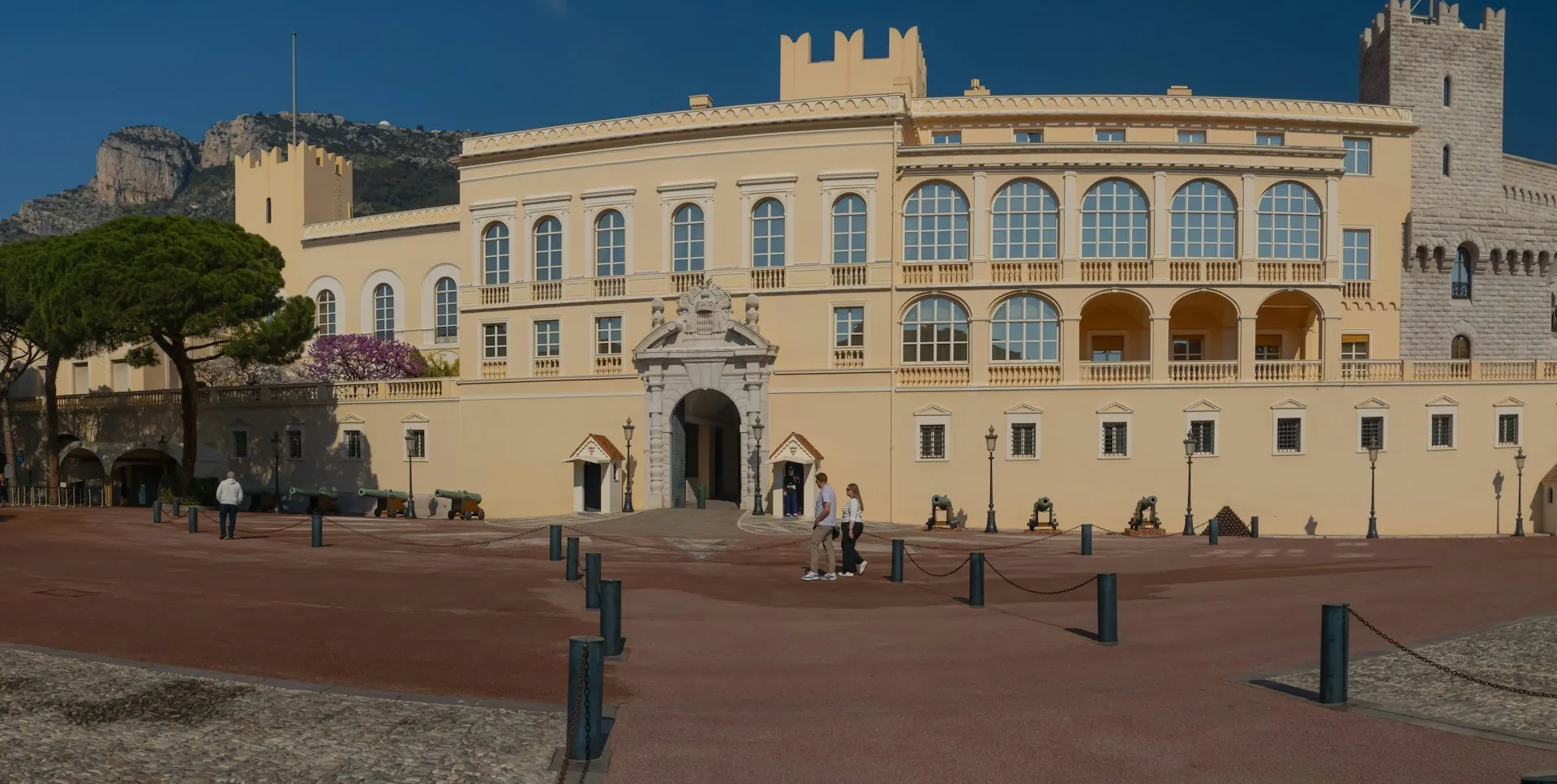
The Prince's Palace
The Grimaldi residence on the Rock; the State Apartments open to visitors in season, and the guard changes daily just before noon.

Try "Saint-Tropez", "Positano", "truffle" or "Cyprus".
Home›History and Culture›Monaco
A fortress taken by a Grimaldi in disguise in 1297, a casino that made a legend and a principality of opera, ballet and the sea: the history and culture of Monaco.
History
The Greeks knew the harbour as the Port of Hercules Monoikos, and the Genoese built a fortress on the Rock in 1215. On a January night in 1297 François Grimaldi, disguised as a Franciscan friar, talked his way through the gate and seized it; the monk with a sword is still on the princely coat of arms, and his family reigns today.
In the 1860s, having lost Menton and Roquebrune, Prince Charles III needed a new fortune. A casino on the plateau of Spélugues was the answer, and in 1866 the new quarter was named Monte-Carlo in his honour. Charles Garnier, architect of the Paris Opéra, built the opera house in 1879. Prince Albert I, a pioneering oceanographer, opened the Oceanographic Museum on the cliff in 1910, and the Grand Prix was first run in 1929.
The Rock is fortified.
François Grimaldi takes the fortress.
The casino and the new quarter named after Charles III.
Charles Garnier's Salle Garnier.
Albert I's temple to the sea.
Prince Rainier III marries the American actress.
The reigning Sovereign Prince accedes.
Arts and letters
The Opéra de Monte-Carlo, Les Ballets de Monte-Carlo and the Monte-Carlo Philharmonic Orchestra give the principality a cultural life far beyond its size. The Nouveau Musée National de Monaco shows contemporary art in two villas, and the Jardin Exotique clings to the cliff above Fontvieille.
Founder of the Oceanographic Museum.
His Ballets Russes made Monte-Carlo their home from 1911.
Her foundation still supports the arts in Monaco.
At the table
Monaco's own dishes are those of the Riviera: barbagiuan, small fried pastries of chard and ricotta, eaten on the National Day, and stocafi, dried cod stewed with tomatoes and olives. Its tables are among the most famous in the world.
Alain Ducasse's flagship.
Steps from the Casino.
Landmarks
Monaco has no site on the UNESCO World Heritage List; these are its great landmarks.
The Grimaldi residence on the Rock; the State Apartments open to visitors in season, and the guard changes daily just before noon.
Built into the cliff on the Rock and opened in 1910.
Charles Garnier's Salle Garnier, joined to the Casino.
Where Princess Grace and Prince Rainier III are buried.
Plan
Before you go, read our notes on customs and etiquette in Monaco: how to greet, what to wear and how to tip.
Keep exploring
Where to stay
The season
Beyond the Mediterranean
History & culture
The Mediterranean Season Letter
Four letters a year, one for each season: the Mediterranean from spring to autumn, and Beyond the Mediterranean, into the Alps, in winter. The one best hotel to book, and the events worth crossing a sea for.
We use Google Analytics cookies to see how visitors use the site. Accept them, or decline and the site works just the same. Privacy