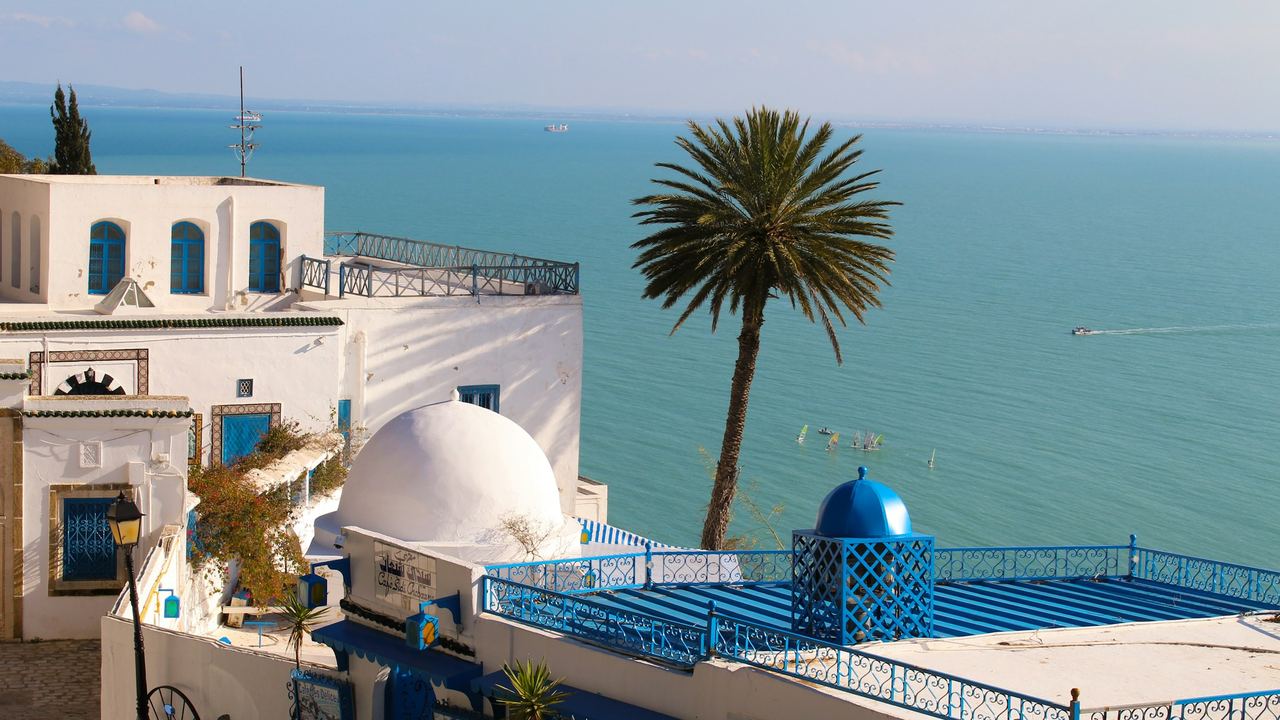
The white walls, blue doors and domes of Sidi Bou Said above the Gulf of Tunis, with a palm tree
TheMediterranean.com The Luxury Gateway
DestinationsStayResortsSailCruisesFlyTrainsLiveLuxury Real EstateShopDineExperiencePlan a Trip

Home›Mediterranean destinations›Tunisia

Tunisia

From the blue-and-white village of Sidi Bou Said and the ruins of Carthage to the medina of Tunis and the great Roman amphitheatre of El Jem: Tunisia, chosen by one rule: first class or not at all.

Sidi Bou Said above the Gulf of TunisPhotograph: Noelle Guirola

الثقافة

Carthage, Rome and the medina

Tunisia was home to Carthage, the Phoenician city that rivalled Rome for the Mediterranean until its fall in 146 BC. Its ruins, on the coast just outside Tunis, are a UNESCO World Heritage Site, as are the medina of Tunis and the holy city of Kairouan.

The Romans rebuilt Carthage and left Tunisia some of their finest monuments: the amphitheatre of El Jem, one of the largest in the world, and the hilltop town of Dougga. The Bardo Museum in Tunis holds one of the greatest collections of Roman mosaics, and above the sea, the white walls and blue doors of Sidi Bou Said have drawn painters since Paul Klee.

This guide brings together only the first class: the museums, the festivals and the ancient sites that meet our standard. No hotel or restaurant yet meets it, and we say so plainly.

A few words of Tunisian Arabic
EnglishTunisian ArabicSay it
Helloعسلامةah-SLEM-a (or French bonjour)
Pleaseيعيشكya-AY-shek (or s'il vous plaît)
Thank youيعيشك / شكراًya-AY-shek / SHUK-ran (or merci)
Good eveningمسا الخيرMSA el-KHEYR (or bonsoir)
The bill, pleaseالحساب يعيشكel-hi-SAAB, ya-AY-shek (or l'addition, s'il vous plaît)

Where to go

The best places to visit in Tunisia

Tunis and Sidi Bou Said: the best time to visit and how to arrive by private jet, helicopter or yacht.

Tunis and Sidi Bou Said

Best time to visitJune and September are ideal: a sea at 22–25°C (72–77°F) and almost no rain, without the 34°C (93–94°F) heat of July and August.

  • Stay
    None that meets our standard yet.
  • Dine
    None that meets our standard yet.
  • Beach
    None that meets our standard yet.
Arrive privately
By private jet
Tunis-Carthage International Airport (TUN / DTTA), about 20 to 30 minutes by car to Sidi Bou Said.
By helicopter
Not a regular option.
By sea
No superyacht marina here yet meets our standard. The marina below Sidi Bou Said takes smaller yachts (draught of about 2 to 3 metres); superyachts usually anchor off Sidi Bou Said, where clearance can be done in under an hour, with yacht agents based at La Goulette, about 15 minutes away by car.

The full Sidi Bou Said guide ›

Beyond the coast

El Jem, Dougga and Kairouan

El Jem

In a small town on the Sahel plain stands one of the largest Roman amphitheatres ever built, a 3rd-century arena that seated about 35,000 spectators. The Amphitheatre of El Jem was inscribed as a UNESCO World Heritage Site in 1979.

Best time to visitMarch to May, and September to November.

  • Stay
    No hotel here yet meets our standard; visit as a day trip from Sousse.

Dougga

A hilltop Roman town in the wheat country of northern Tunisia, with its capitol, theatre, temples and houses unusually complete. Dougga/Thugga was inscribed as a UNESCO World Heritage Site in 1997.

Best time to visitMarch to May, and September to November.

  • Stay
    No hotel here yet meets our standard; visit as a day trip from Tunis.

Kairouan

Founded in 670, Kairouan was the first great Islamic city of the Maghreb, and its Great Mosque is one of the oldest and most important in North Africa. Kairouan was inscribed as a UNESCO World Heritage Site in 1988.

Best time to visitMarch to May, and October to November.

  • Stay
    No hotel here yet meets our standard; visit as a day trip from Sousse.

Cruises

Tunisia by sea

The cruise ports of Tunisia, and where the luxury lines call.

Ships call at La Goulette, the port of Tunis, a short drive from Carthage and Sidi Bou Said.

Where the luxury lines call

From the lines' own 2026 and 2027 voyages. Ports change from season to season, so check the voyage before you reserve.

Experience

Events and things to do in Tunisia

The Tunisian year: the great events, month by month; each event's own website gives this year's dates.

The great museums

  • Bardo National MuseumTunis

    A 19th-century royal palace, opened as a museum in 1888, with one of the world's largest collections of Roman mosaics, including the Virgil Mosaic. Visit website (opens the official site) ↗

Opera houses, concert halls and festivals

  • Roman Theatre of Carthage

    The 7,500-seat ancient theatre that has hosted the International Festival of Carthage each July and August since 1964, with names from Ray Charles to Charles Aznavour. Visit website (opens the official site) ↗

  • Amphitheatre of El Jem

    The largest Roman amphitheatre in North Africa, built around AD 238 for some 35,000 spectators and a UNESCO World Heritage Site since 1979, where symphony orchestras play each summer at the El Jem International Symphonic Music Festival.

Plan your trip

Luxury travel in Tunisia and the Mediterranean: your questions answered

When is the best time to visit Tunisia?

June and September are ideal: a sea at 22–25°C (72–77°F) and almost no rain, without the 34°C (93–94°F) heat of July and August.

How do you arrive in Tunisia by private jet?

Tunis-Carthage International Airport (TUN / DTTA), about 20 to 30 minutes by car to Sidi Bou Said.

Do you tip in Tunisia?

Not mandatory in local cafés, restaurants or taxis, where leaving loose change is customary. Restaurants used to visitors generally expect around 10%. Small cash tips for drivers are appreciated. Luxury hotels: porters the equivalent of €2–5 a bag, housekeeping €5–10 a day, in Tunisian dinars.

What should you wear in Tunisia?

Tunisia is more conservative than Southern Europe but relaxed by regional standards; Western clothing is normal in cities and resorts. Cover shoulders and knees for mosques and religious sites, and bring a scarf. Keep swimwear to the beach, pool or boat, and dress more modestly outside resorts and in rural areas. On yachts, no hard-soled shoes on deck. Fine dining is smart-casual.

More of the Mediterranean

Luxury travel across the Mediterranean

Customs and etiquette

Customs and etiquette in Tunisia

How Tunisia does things.

Language
Arabic is the official language, spoken daily as Tunisian Arabic (Derja). French is spoken by most Tunisians and is the working language of hotels, restaurants and business. English is less common, though staff at luxury hotels usually speak it.
Greetings
A handshake is standard, though some women may prefer not to shake hands with men; follow their lead. Cheek kisses are used between friends and family but are not universal, so let the other person set the tone. French greetings (bonjour, bonsoir) are perfectly natural.
Dress
Tunisia is more conservative than Southern Europe but relaxed by regional standards; Western clothing is normal in cities and resorts. Cover shoulders and knees for mosques and religious sites, and bring a scarf. Keep swimwear to the beach, pool or boat, and dress more modestly outside resorts and in rural areas. On yachts, no hard-soled shoes on deck. Fine dining is smart-casual.
Dining
Lunch is typically from about 12.30–2.30 pm and dinner from about 8 pm, later in summer. Reserve at well-known restaurants in Tunis, Sidi Bou Said and Hammamet.
Tipping
Not mandatory in local cafés, restaurants or taxis, where leaving loose change is customary. Restaurants used to visitors generally expect around 10%. Small cash tips for drivers are appreciated. Luxury hotels: porters the equivalent of €2–5 a bag, housekeeping €5–10 a day, in Tunisian dinars.
Good to know
During Ramadan and in July and August, offices work a shortened day (roughly 7.30 am–1.30 pm), and during Ramadan many shops and cafés close in daylight hours and reopen after sunset. The Tunisian dinar cannot be taken out of the country, so change only what you need.

Every list on this page is checked by hand and dated: last checked October 2026. Hotels, restaurants and events link only to their own official websites, where confirmed.

The Mediterranean Season Letter

Where to be, every season

Four letters a year, one for each season: the Mediterranean from spring to autumn, and Beyond the Mediterranean, into the Alps, in winter. The one best hotel to book, and the events worth crossing a sea for.