Home›Music Venues
Music Venues
The great opera houses, concert halls and open-air stages, from La Scala and the Liceu to the Arena di Verona.
Last checked October 2026.
Try "Saint-Tropez", "Positano", "truffle" or "Cyprus".
Home›Music Venues
The great opera houses, concert halls and open-air stages, from La Scala and the Liceu to the Arena di Verona.
Last checked October 2026.
Rem Koolhaas's concert hall, conceived to mark Porto's year as European Capital of Culture and opened in 2005, a landmark of modern architecture with a 1,300-seat main auditorium.
Opened on La Rambla in 1847 and rebuilt after a fire in 1994, reopening in 1999. Visit website (opens the official site) ↗
Lluís Domènech i Montaner's 1908 concert hall, a UNESCO World Heritage Site, under a gold-and-blue stained-glass skylight representing the sun and sky. Visit website (opens the official site) ↗
Spain's leading opera house, opened in 1850, facing the Royal Palace. Visit website (opens the official site) ↗
Santiago Calatrava's opera house, opened in 2005 in the City of Arts and Sciences. Visit website (opens the official site) ↗
The palaces and gardens of the Alhambra and the Generalife, the stage of the Granada International Festival of Music and Dance each summer since 1952. Visit website (opens the official site) ↗
Opera, ballet and concerts in the gardens of Peralada Castle each summer, a festival held since 1987. Visit website (opens the official site) ↗
Charles Garnier's opera house, opened in 1875, with a ceiling painted by Marc Chagall and the setting of The Phantom of the Opera. Visit website (opens the official site) ↗
Jean Nouvel's 2,400-seat concert hall, opened in 2015. Visit website (opens the official site) ↗
A UNESCO site whose 37-metre stage wall still stands complete, home of the Chorégies d'Orange opera festival, with roots going back to 1869. Visit website (opens the official site) ↗
The open-air stage in the old Archbishop's Palace courtyard where the Aix Festival began in 1948. Visit website (opens the official site) ↗
The Salle Garnier inside the Monte-Carlo Casino, designed by Charles Garnier and opened in 1879 with Sarah Bernhardt. Visit website (opens the official site) ↗
Opened in 1778; Verdi's Otello and Puccini's Madama Butterfly and Turandot premiered here. Visit website (opens the official site) ↗
Opened in 1880 as the Teatro Costanzi, where Mascagni's Cavalleria rusticana and Puccini's Tosca premiered; each summer since 1937 the company has also staged opera in the ruins of the Baths of Caracalla; while the baths are restored, the summer season moved to the Circus Maximus in 2026.
Opened in 1737, the oldest continuously active opera house in the world. Visit website (opens the official site) ↗
Opened in 1792 and rebuilt after fires in 1836 and 1996; Verdi's La traviata and Rigoletto premiered here. Visit website (opens the official site) ↗
Italy's largest opera house, opened in 1897, where the final scenes of The Godfather Part III were filmed. Visit website (opens the official site) ↗
A Roman amphitheatre from about AD 30, home to a summer opera festival since a 1913 Aida. Visit website (opens the official site) ↗
Opened in 1829; it has staged every Verdi opera and hosts the Festival Verdi each autumn. Visit website (opens the official site) ↗
The gardens high above the Amalfi Coast that Wagner saw as Klingsor's garden in Parsifal in 1880, home of the Ravello Festival since 1953. Visit website (opens the official site) ↗
Rossini's hometown on the Adriatic has given his operas, many in new critical editions, each August since 1980, at the Teatro Rossini and the city's larger halls. Visit website (opens the official site) ↗
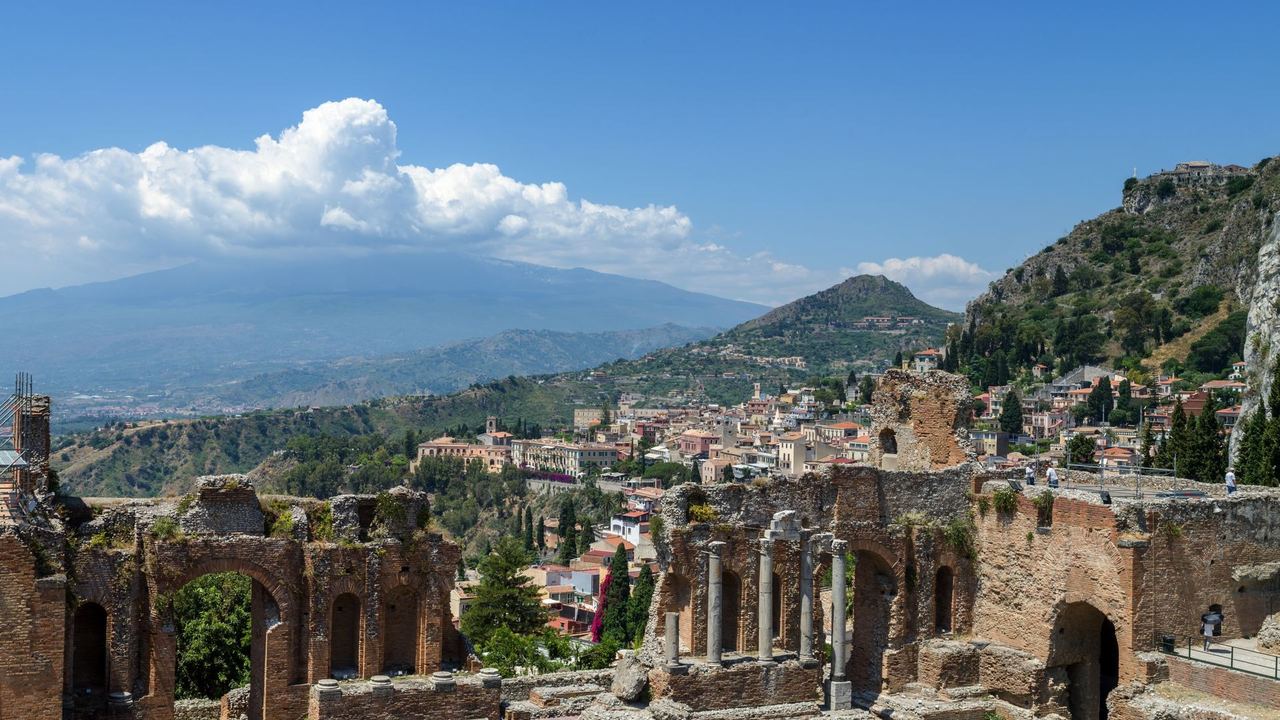
A Greek theatre rebuilt by the Romans, with summer concerts, opera and ballet overlooking the Ionian Sea and Mount Etna.
Malta's national theatre, opened in 1732 and said to be the third-oldest working theatre in Europe. Visit website (opens the official site) ↗
The capital's neo-Renaissance opera house, built in 1890 to 1892 by the Czech architects Jan Vladimír Hráský and Anton Hruby and restored in 2011. Visit website (opens the official site) ↗
The former Teutonic Knights' monastery that Jože Plečnik turned into an open-air theatre in the 1950s, his last major work, and the main stage of the summer Ljubljana Festival, first held in 1953. Visit website (opens the official site) ↗
One of the best-preserved Roman amphitheatres in the world and the only one with its entire outer wall intact. It hosts concerts, opera and ballet. Visit website (opens the official site) ↗
Since 1950 it has staged classical music, theatre, opera and dance across the walled city each July and August, from Hamlet on Fort Lovrijenac to concerts in the atrium of the Rector's Palace. Visit website (opens the official site) ↗
The colonnaded court of the Roman emperor's palace, the open-air opera stage of the Split Summer Festival, founded in 1954 and held each July and August. Visit website (opens the official site) ↗
None that meets our standard yet.
None that meets our standard yet.
None that meets our standard yet.
Completed in AD 161 on the slope of the Acropolis, and the main stage of the Athens Festival. Visit website (opens the official site) ↗
The 4th-century BC theatre of the sanctuary of Asclepius, a UNESCO World Heritage Site famous for its acoustics, where the Athens Epidaurus Festival stages ancient Greek drama each summer. Visit website (opens the official site) ↗
Renzo Piano's 2016 home of the Greek National Opera and the National Library. Visit website (opens the official site) ↗
Opened in 1991, with four halls, the largest seating nearly 2,000. Visit website (opens the official site) ↗
The best-preserved theatre of the ancient world (AD 155), home of the Aspendos International Opera and Ballet Festival since 1994.
The city's great arts centre on Taksim Square, rebuilt and reopened in 2021, with concert halls and a theatre. Visit website (opens the official site) ↗
Open-air opera every late summer since 1999, staged in front of the medieval castle at the harbour.
None that meets our standard yet.
Founded in 1956 among the Roman temples of Baalbek, a UNESCO World Heritage Site, where the 2025 edition staged Bizet's Carmen at the Temple of Bacchus. Its stage has drawn Fairuz and the Rahbani brothers, Mstislav Rostropovich, the Paris Opera, the Béjart Ballet, Charles Aznavour and Sting. Visit website (opens the official site) ↗
Home of the Israel Philharmonic Orchestra, founded in 1936 by Bronisław Huberman with a first concert under Arturo Toscanini; the hall opened in 1957 with Leonard Bernstein and Arthur Rubinstein, and was renovated in 2011 to 2013 with acoustics by Yasuhisa Toyota. Visit website (opens the official site) ↗
The national opera company, founded in 1985, at home since 1994 in the Tel Aviv Performing Arts Center, whose foyer was designed by Ron Arad. Visit website (opens the official site) ↗
The Roman theatre built in the time of Herod, now in Caesarea National Park, seating about 4,000 for concerts beside the Mediterranean. Visit website (opens the official site) ↗
Opened in 1988 on Gezira Island as a gift from Japan, successor to the Khedivial Opera House of 1869, which burned in 1971; it is home to most of Egypt's finest musical companies. Visit website (opens the official site) ↗
None that meets our standard yet.
The 7,500-seat ancient theatre that has hosted the International Festival of Carthage each July and August since 1964, with names from Ray Charles to Charles Aznavour. Visit website (opens the official site) ↗
The largest Roman amphitheatre in North Africa, built around AD 238 for some 35,000 spectators and a UNESCO World Heritage Site since 1979, where symphony orchestras play each summer at the El Jem International Symphonic Music Festival.
None that meets our standard yet.
Zaha Hadid's theatre in the Bouregreg valley, opened to the public in spring 2026, with an 1,800-seat auditorium and a 7,000-seat open-air amphitheatre. Visit website (opens the official site) ↗
That makes 43 entries in all.
The Mediterranean Season Letter
Four letters a year, one for each season: the Mediterranean from spring to autumn, and Beyond the Mediterranean, into the Alps, in winter. The one best hotel to book, and the events worth crossing a sea for.
We use Google Analytics cookies to see how visitors use the site. Accept them, or decline and the site works just the same. Privacy