Home›The Alps›Getting Around the Alps
Getting Around the Alps
Helicopter transfers, altiports, chauffeurs and the great panoramic trains.
Last checked October 2026.
Try "Saint-Tropez", "Positano", "truffle" or "Cyprus".
Home›The Alps›Getting Around the Alps
Helicopter transfers, altiports, chauffeurs and the great panoramic trains.
Last checked October 2026.
Air Charter Service ranks it the most popular airport for private-jet ski travellers in Europe, for its access to the Tarentaise resorts such as Courchevel, Méribel and Val d'Isère. The 2,020 m runway has a dedicated FBO, and winter weekend arrivals need prior permission. Visit website (opens the official site) ↗
At 2,008 m, its 18.5% runway is among the steepest in the world: aircraft land uphill and take off downhill, and pilots need special qualification. Commercial charter landings are tightly limited by the French civil aviation authority, so most guests arrive by helicopter or small turboprop from Geneva or Chambéry.
At about 1,700 m at the top of Méribel, beside Le Kaïla, with a 406 m by 15 m asphalt runway whose central section slopes at about 11%. It takes light aircraft, has no control tower, and pilots need special mountain qualification.
At 1,470 m on the Côte 2000 site above Megève, opened in 1964, with a 600 m runway for light aircraft and helicopters. Pilots need mountain-landing qualification; it is used for VIP transfers and sightseeing flights.
A 3,050 m runway takes any business jet, serving the Oisans and southern French resorts; it is a quieter alternative to Chambéry, though February fills early and prior permission is needed. Visit website (opens the official site) ↗
Lyon's main international airport and a large-runway gateway to the northern French Alps for aircraft of any size. Business aviation is handled 24 hours a day by Lyon Airports Executive Handling, the airport operator's own FBO, with Space Executive Handling listed as an additional handler. Visit website (opens the official site) ↗
Lyon's dedicated business-aviation airport, on the eastern edge of the city, with a 1,820 m by 45 m grooved runway that takes long-range business jets. Lyon Airports Executive Handling runs the FBO (about 07:00 to 20:00 local, later on request), with fuel, de-icing and hangars on site. Flights from outside the Schengen area must give customs 24 hours' notice on weekdays, or notice by 17:00 on the last business day before a weekend or holiday. Visit website (opens the official site) ↗
Beside Lake Annecy in Haute-Savoie, the closest jet runway to the Mont Blanc country resorts, with one runway of 1,630 m. VINCI Airports has run the airport since January 2022 under a 15-year concession and describes it as specialising in business and leisure aviation. A rebuilt terminal opened in May 2026 with three passenger lounges and a dedicated crew area.
One of Europe's busiest business-aviation airports, with private terminals run by Signature, Jet Aviation, Dassault Aviation and Swissport Executive. It is the main gateway for Verbier, Megève, Chamonix and the Savoie resorts, about 25 minutes from Courchevel by helicopter.
Among Europe's busiest airports for private-jet ski arrivals, it is the main long-range gateway for St. Moritz, Davos, Klosters, Andermatt and the Arlberg.
A low-congestion airport that rarely needs slots, used as the winter jet airport for Gstaad when the Saanen runway takes only turboprops. Visit website (opens the official site) ↗
The nearest fixed-wing airport to the Valais resorts, about 25 km from Crans-Montana and 40 km from Verbier, with a Signature Flight Support terminal and customs. Pilots need special Swiss authorisation and training.
The airfield for Gstaad, taking jets up to 15,000 kg in summer and turboprops such as the Pilatus PC-12 in winter; Air-Glaciers has run its helicopter base here since 1989. Visit website (opens the official site) ↗
At 1,707 m, one of the highest airports in Europe, 6 km from St. Moritz, with on-site customs and a Universal Aviation FBO. Pilots need prior training, and slots are scarce over Christmas, New Year and the February White Turf race weekends. Visit website (opens the official site) ↗
At Agno, about 6 km from central Lugano on Lake Lugano and close to the Italian border, serving the Ticino lakes. The single 1,420 m runway has one of Europe's steepest instrument approaches (6.65 degrees), and the airport tells operators to check aircraft suitability with its handling team. There are no slots. Normal hours are 08:00 to 12:00 and 13:30 to 20:00. Aircraft over 3 tonnes can arrange 07:00 to 22:00 with 48 hours' prior permission, which is not granted automatically. There are no scheduled airline flights, and business aviation is handled by the airport's own general-aviation team. Visit website (opens the official site) ↗
On the Swiss shore of Lake Constance, about one hour from Zurich, with quick access to Lech and Zürs in the Arlberg and to Klosters and Davos. The airport is its own FBO and handling agent, and ExecuJet also runs an FBO with VIP and crew lounges, customs and helicopter transfers. The 1,455 m runway takes jets up to the Global 7000, Gulfstream G650 and Falcon 8X. There are no slots, but the airport closes over the midday break and keeps limited evening and Sunday hours. Visit website (opens the official site) ↗
SEA Prime's private-aviation terminal at Linate was enlarged to about 1,950 m² after the Winter Olympics traffic; it is the closest of the Milan airports to Lake Como and a usual entry for the Valtellina.
Malpensa is the main long-haul gateway to the Italian Lakes and the western Alps, about an hour's drive from Lake Como and under an hour from Lake Maggiore, with St. Moritz about three hours away. Business and general aviation uses Prime Malpensa, a dedicated terminal run by SEA Prime (part of SEA, the Milan airports operator) that opened in July 2019 between Terminals 1 and 2 and operates 24/7, with a 1,400 m² terminal, a 50,000 m² apron and a 5,000 m² hangar.
Bergamo sits about 45 km east of Milan and is the closest major airport to Lake Iseo and the Bergamo and Brescia valleys, with Lake Como about an hour away. Since June 2025 private flights use BGY Executive, a general aviation terminal built by airport operator SACBO near Customs Gate 2, where on-site border, customs and finance-police formalities are handled and two lounges are run by the FBOs Italy FBO (Delta Aerotaxi) and Skyservices. The runway is 2,874 m. Visit website (opens the official site) ↗
Venice is the main gateway to Cortina d'Ampezzo and the eastern Dolomites, about two hours' drive north via the A27. Private aircraft are handled by Venice General Aviation, the airport's own FBO set up in the late 1980s, which offers private lounges and water-taxi docks reached straight from the apron. The airport has no slot requirement for business aviation but prior permission (PPR) is required, general aviation parking is limited to a handful of stands and usually capped at about 72 hours, and the GA terminal is staffed 06:00 to 22:00 local with overtime on request. Visit website (opens the official site) ↗
Treviso is about 30 minutes from Venice and joins the same A27 route north to Cortina and the Dolomites, typically saving only ten to fifteen minutes on the drive compared with Venice. It is less congested than Venice Marco Polo, with full ground handling and easier aircraft parking, and is operated within the same airport group as Venice.
Verona is the main airport for Lake Garda, about 20 km from the lake, and also gives motorway access north via the A22 Brenner corridor to Trentino resorts such as Madonna di Campiglio. It has a single 3,068 m runway and is operated by Aeroporto Valerio Catullo, part of the GardaAeroporti system. Visit website (opens the official site) ↗
Bolzano is the airport inside the Dolomites, beside the A22 Brenner motorway, about an hour from Val Gardena and the Merano area and about an hour to an hour and a quarter from Alta Badia. It is run by ABD Airport, has a 1,432 m runway at 240 m elevation, has Jet A1 and Avgas, and is open for flight operations 06:30 to 23:00 local; its short runway and mountain approach limit which business jets can use it, and operators should check the airport's pilot information before planning. Visit website (opens the official site) ↗
Turin is the gateway to the Via Lattea ski area (Sestriere, Sauze d'Oulx) about 1.5 hours west, and to the Aosta Valley resorts. It has a 3,300 m runway and a dedicated general aviation terminal alongside the passenger and cargo terminals; the airport is operated by SAGAT. Visit website (opens the official site) ↗
Aosta is the closest airport to Courmayeur (about 40 minutes), Cervinia (about an hour) and the Monte Rosa valleys. It has a 1,499 m (4,918 ft) runway at 1,796 ft elevation, is an airport of entry with customs, has Jet A1 and Avgas, operates in daylight hours only, and requires handling to be arranged in advance; no slots are needed.
Its General Aviation Terminal, long described as the most popular private-jet terminal in Germany, is the jet gateway for the Bavarian Alps, Garmisch-Partenkirchen and Schloss Elmau, and an alternative for Kitzbühel and the Tyrol when larger jets cannot use Innsbruck. For smaller jets, Innsbruck is the usual, closer choice for Garmisch and Elmau. Visit website (opens the official site) ↗
A business-aviation and works airfield southwest of Munich, about 15 minutes by car from Lake Starnberg (Starnberger See) and a practical alternative to Munich International for the Bavarian Alps. It takes only qualified business flights, with prior permission (PPR) required, for aircraft from 2 t to 25 t maximum take-off mass, including the Global, Falcon and Gulfstream series; ground handling is by TRIWO for the operator EDMO-Flugbetrieb GmbH, with border-police and customs clearance on site. The single runway (04/22) is about 2,290 m long, and published hours are weekdays 07:00–21:00 local and otherwise by appointment. Visit website (opens the official site) ↗
On the north shore of Lake Constance, it is a short route into Vorarlberg and the Arlberg: about 100 km to Montafon, 124 km to Lech and 132 km to St. Anton am Arlberg, with typical drives of about 1¼ to 2 hours. The 2,356 m runway takes current business jets, and general-aviation hours are 06:00–22:00 local on weekdays and 09:00 to 30 minutes after sunset (20:00 at the latest) at weekends and on public holidays. Weekend and holiday extensions need prior permission, requested one business day ahead. Visit website (opens the official site) ↗
The jet airport for Lech, Zürs, St. Anton and Kitzbühel, best suited to smaller jets; slots are required and crews need simulator training for low-visibility approaches. Visit website (opens the official site) ↗
A 2,750 m (9,022 ft) runway with a Category III landing system serves Kitzbühel, the Salzburger Land resorts and the Salzburg Festival; private arrivals need prior permission from mid-December.
The gateway to Carinthia's lakes and ski areas: Velden on Lake Wörthersee is about 20 km away, and Bad Kleinkirchheim about 70 km. A General Aviation Center (GAC) handles private and business flights, with the airport's own VIP service offering help with travel formalities and customs, direct apron access by car and expedited security; it asks for 24 hours' notice. The concrete runway is 2,720 m, and the airport is open daily from early morning to late evening, with hours varying by day of the week. Visit website (opens the official site) ↗
Founded in 1992, it runs luxury helicopter transfers across the French Riviera, Monaco and the French Alps, including Courchevel. Visit website (opens the official site) ↗
Private and scheduled helicopter flights into Courchevel Altiport, about 25 minutes from Geneva and 14 minutes from Val d'Isère, with direct flights from Monaco. Visit website (opens the official site) ↗
Founded in 1965 in the Valais, with seven bases including Sion and Gstaad-Saanen; it flies helicopter taxis to Swiss and European destinations, glacier landings and scenic flights. It joined Air Zermatt in 2020, and both companies keep their own names. Visit website (opens the official site) ↗
Founded in 1968 in car-free Zermatt, known for its mountain-rescue work, it runs taxi flights, transfers and sightseeing flights over the Matterhorn and Monte Rosa. Visit website (opens the official site) ↗
Heli-skiing is banned in France; skiers from Chamonix and Megève are taken across the border into Italy or Switzerland. It is permitted in Switzerland at designated mountain landing sites and in designated areas of Italy, notably Monte Rosa and the Aosta Valley. In Austria it is allowed only at Lech Zürs, under a permit that runs to at least 2027. There is none in the Bavarian Alps.
Founded in 1821, the first mountain-guide company in the world, with about 160 high-mountain guides based at the Maison de la Montagne in Chamonix; it guides mountaineering, ski touring and off-piste days across the Mont Blanc massif. Visit website (opens the official site) ↗
One of the best-known heli-ski areas in Europe, with drops on the glaciers around Zermatt and Monte Rosa, always flown with a mountain guide. Visit website (opens the official site) ↗
The Gstaad base and the Valais bases fly guided heli-ski days with certified mountain guides. Visit website (opens the official site) ↗
Founded in 1996, a team of IFMGA mountain guides from the Aosta Valley running heli-skiing on Monte Rosa, with landings above 4,000 m, and guided heli-ski days from Courmayeur with transfers from Chamonix. Visit website (opens the official site) ↗
Guided heli-skiing from Ayas and Gressoney on Monte Rosa, flown by Rotorwork for four clients and a guide, with descents of more than 2,000 m. Visit website (opens the official site) ↗
The only heli-skiing in Austria: Wucher Helicopter flies from the Flexen Pass or Kriegerhorn to Mehlsack (2,652 m) and Schneetäli (2,450 m), on weekdays only from December to May, booked through the local ski schools with a certified guide. Visit website (opens the official site) ↗
Launched in 2019, a carriage of 20 guaranteed window seats with a concierge, a five-course meal with wines and a private bar, on the eight-hour route between Zermatt and St. Moritz across 291 bridges and through 91 tunnels.
The top class on the panoramic line linking Montreux, Gstaad and Interlaken, used by premium rail tours alongside the Glacier Express Excellence Class.
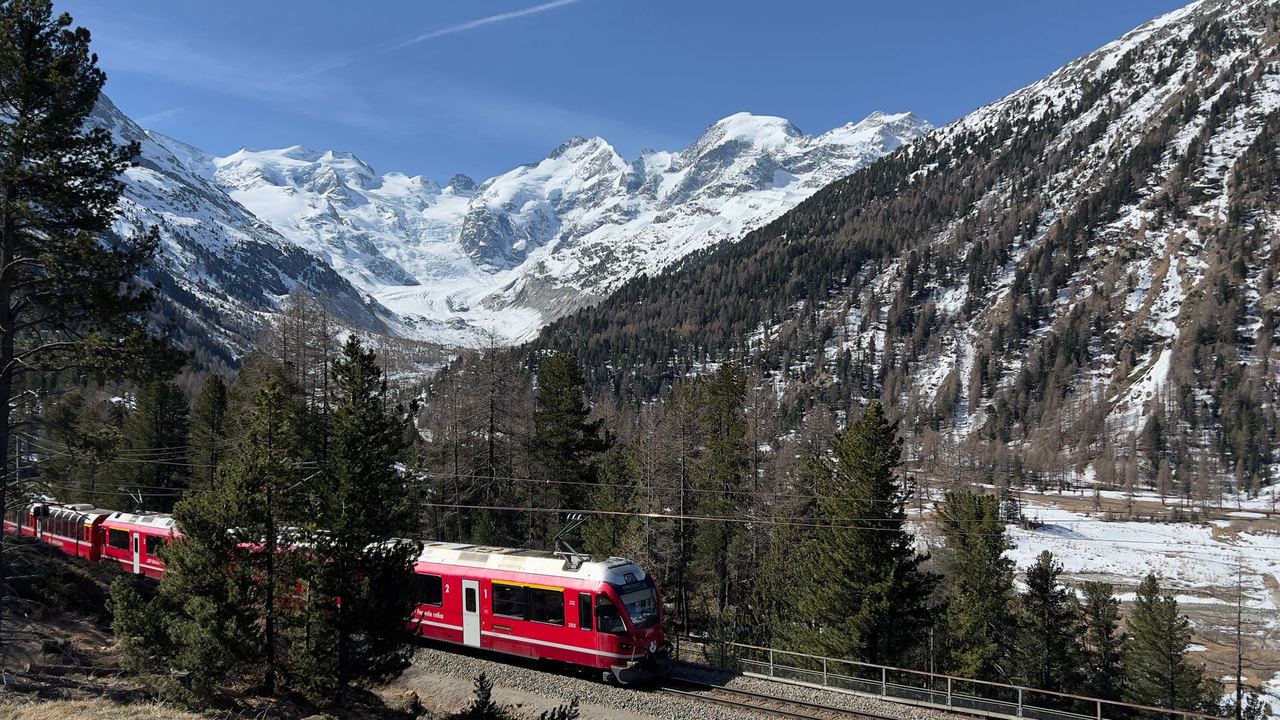
The panoramic train from St. Moritz over the Bernina Pass to Tirano in Italy; recommended in first class only.
The restored 1920s and 1930s carriages run between Paris and Venice from March to December, a journey that crosses the Alps.
Founded in 1999 near Zurich Airport, with Mercedes S-Class, Audi A8L and Mercedes GLS cars, serving Zurich, Geneva, St. Moritz, Davos and Lugano. Visit website (opens the official site) ↗
Founded in Paris in 1921 and still family-run in its fourth generation (its founder was among the founders of Les Clefs d'Or), with winter offices in Courchevel, Megève and Val d'Isère; Mercedes S-Class and V-Class cars and Range Rovers meet guests at Geneva and Lyon airports and at Chambéry, Moûtiers and Bourg-Saint-Maurice stations. Visit website (opens the official site) ↗
That makes 47 entries in all.
The Mediterranean Season Letter
Four letters a year, one for each season: the Mediterranean from spring to autumn, and Beyond the Mediterranean, into the Alps, in winter. The one best hotel to book, and the events worth crossing a sea for.
We use Google Analytics cookies to see how visitors use the site. Accept them, or decline and the site works just the same. Privacy